
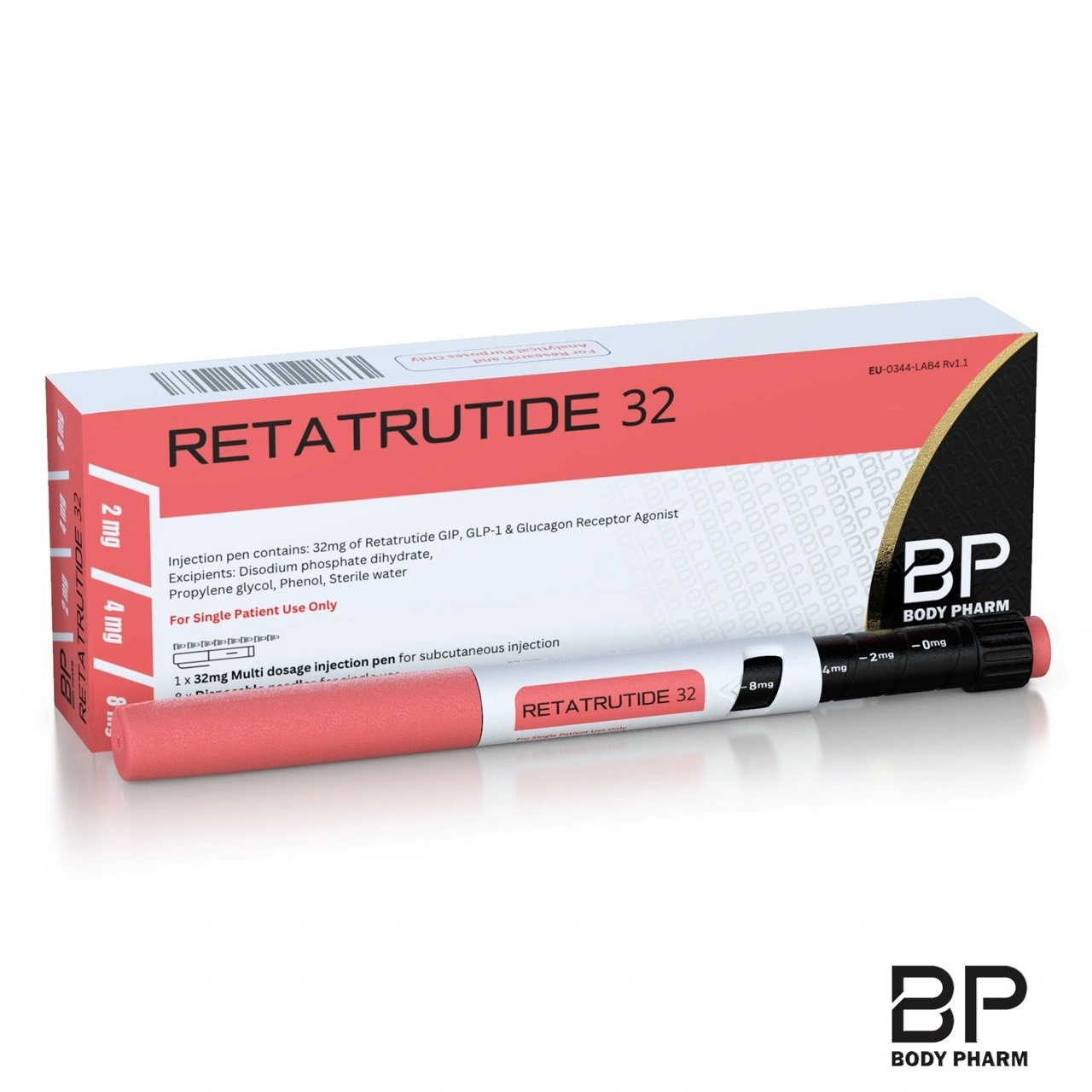
Retatrutide and cagrilintide are different research molecules, and CagriSema is not another spelling of either one. For a reader in Bali comparing weight-management research, separating those names is the first step toward understanding the results.
The retatrutide listing identifies Peptides in Bali's catalogue product. Cagrilintide and CagriSema are discussed as research comparators, not as products in this catalogue or instructions for combining substances.
Three names refer to different interventions
Lilly describes retatrutide as an investigational GIP, GLP-1 and glucagon receptor agonist. Cagrilintide is a long-acting amylin analogue investigated in a phase 2 weight-management trial.
CagriSema refers to the combination of cagrilintide and semaglutide. That combination has its own trial question. It should not be reduced to the effect of cagrilintide alone.
| Name | Research identity | Common misunderstanding |
|---|---|---|
| Retatrutide | GIP/GLP-1/glucagon receptor agonist | Treating every development molecule as another GLP-1 brand |
| Cagrilintide | Amylin analogue | Calling it semaglutide or a GLP-1 agonist |
| CagriSema | Cagrilintide plus semaglutide | Assigning the combination result to cagrilintide alone |
| Retatrutide plus cagrilintide | A different proposed combination | Assuming a CagriSema trial tested it |
The names are not a menu of interchangeable components. Each claimed result must stay attached to the intervention that was actually studied.
Why combination-trial results need careful reading
The REDEFINE 1 report studied coadministered cagrilintide and semaglutide in adults with overweight or obesity. It did not test a retatrutide-and-cagrilintide product.
That distinction prevents two mistakes. First, the combination's outcome should not be attributed entirely to one ingredient. Second, evidence about one combination cannot establish the effects of replacing a component with another molecule.
A headline may be short, but the underlying intervention is not optional detail. Keep the full treatment name beside the result whenever comparing studies.
Different mechanisms do not provide a winner by themselves
A receptor or hormone-pathway description helps explain the scientific rationale. It cannot show which intervention produces the most useful outcome for an individual.
The same applies to counting pathways. Three named receptor targets do not automatically establish superiority over an amylin-related approach. A comparison also needs the population, comparator, duration, outcome and adverse-effect information.
Our retatrutide triple-agonist guide explains that mechanism terminology. This article adds the distinction between a single molecule and a studied combination.
How to compare trial reports without building a misleading league table
Start with the actual research question. Did the study compare active treatments directly, or did each treatment come from a separate study? Were the populations and endpoints sufficiently similar to make the proposed comparison informative?
Then look at what happened to participants who stopped treatment or did not complete follow-up. Different analysis choices can influence the reported result.
For example, a study enrolling people with one metabolic condition may not answer the same question as a study excluding that condition. Record the inclusion criteria beside the outcome. This makes the limits visible before a comparison is summarized as a recommendation.
Finally, keep efficacy and tolerability in the same discussion. A large headline number is not the entire clinical decision. This article deliberately does not rank unrelated trial percentages as though they were a direct head-to-head experiment.
What this means for a Bali product enquiry
A visitor may encounter several molecule names while searching from a hotel or villa and assume they describe locally interchangeable options. A scientific comparison does not establish local availability, regulatory authorization or product equivalence.
For a catalogue question, identify the exact listed retatrutide format and its corresponding documents. For a clinical question, bring the actual trial or paper to a qualified professional and explain the health issue behind the search.
The retatrutide versus tirzepatide guide covers another comparator. Reading multiple comparisons should make the questions more precise, not encourage an improvised combination plan.
FAQ
Is cagrilintide a GLP-1 agonist?
Cagrilintide is described in the cited research as a long-acting amylin analogue. CagriSema includes semaglutide as a separate component.
Does CagriSema mean cagrilintide alone?
No. It refers to the cagrilintide-and-semaglutide combination. The full name of the studied intervention matters when interpreting results.
Do the cited studies validate retatrutide plus cagrilintide?
No. The CagriSema trial does not test that substitution or combination. Separate ingredient studies do not establish a personal combined regimen.
Does a retatrutide research paper validate any pen bearing the name?
No. Research results concern the specified preparation and study setting. The catalogue listing must be identified separately, and the clinical decision needs its own assessment.
Sources and further reading
- What to know about retatrutide — Eli Lilly. Source checked 2026-10-20.
- Once-weekly cagrilintide for weight management in people with overweight and obesity — Lau et al., The Lancet. Source checked 2026-10-20.
- Coadministered Cagrilintide and Semaglutide in Adults with Overweight or Obesity — Garvey et al., New England Journal of Medicine. Source checked 2026-10-20.