
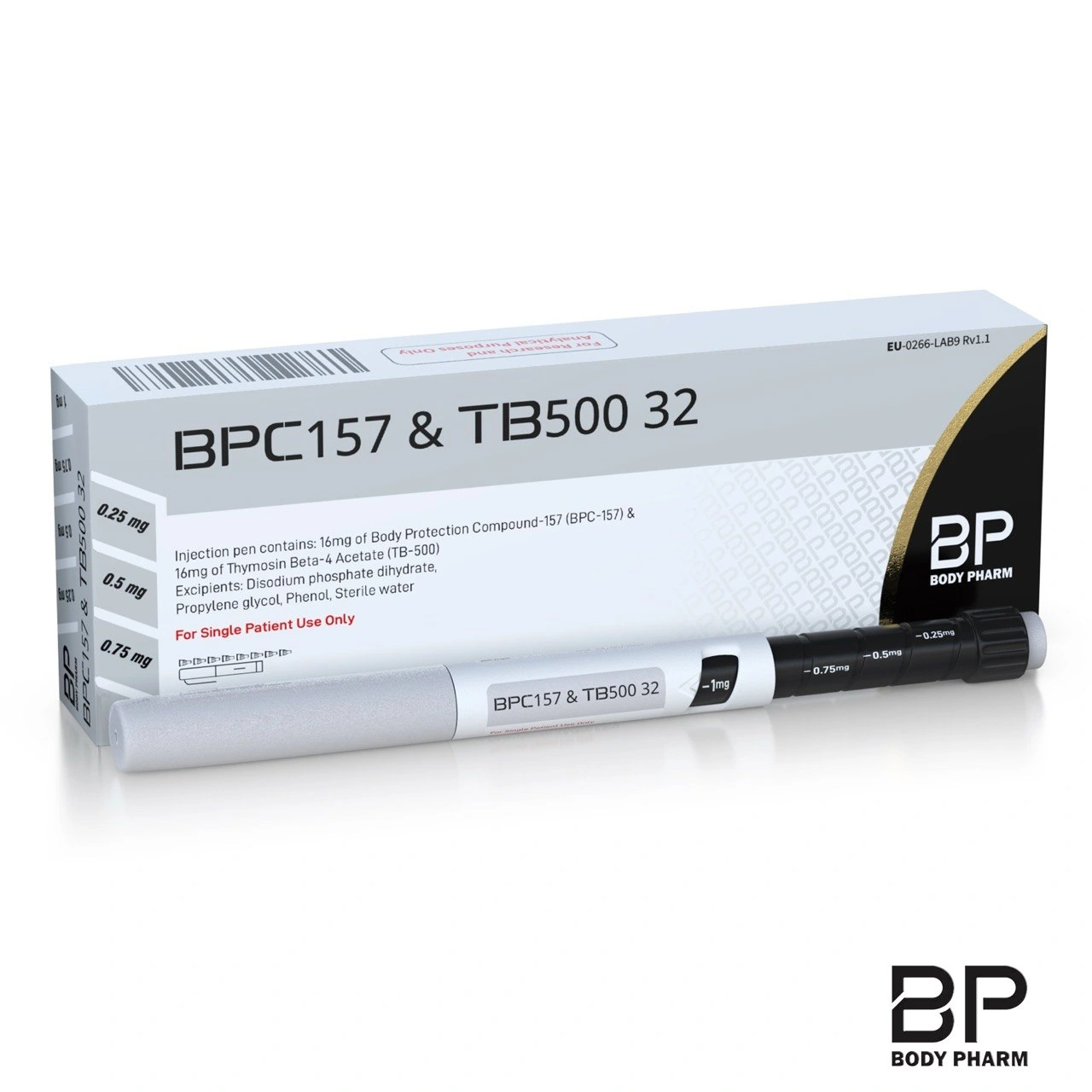
A BPC-157/TB-500 pen and physiotherapy are not equivalent ways to describe recovery care. For someone dealing with pain or reduced function in Bali, the first question is what the problem is and what needs to improve. A product category cannot supply that diagnosis.
Peptides in Bali's BPC-157/TB-500 listing identifies the catalogue blend. This article explains what the published knee-pain evidence can and cannot say about replacing rehabilitation with that product.
The often-cited knee report was not a physiotherapy comparison
A retrospective BPC-157 knee-pain report described a small clinical series involving intra-articular treatment. It did not randomize people between a retail blended pen and a physiotherapy programme.
That leaves several unanswered questions. A retrospective report cannot isolate all the reasons symptoms changed. An injection into a joint in a clinical report is also not the same intervention as every commercially listed pen.
The study can be discussed as preliminary evidence in its actual setting. It cannot establish that rehabilitation is unnecessary or that one product restores function better than an assessed rehabilitation plan.
Pain relief and restored function are different outcomes
A person may care about pain, walking, returning to a sport or tolerating a normal day. These goals overlap, but they are not identical. A useful recovery assessment states which outcome is being measured.
| Desired change | Information that helps assess it | What a product label cannot provide |
|---|---|---|
| Less pain | Location, pattern, clinical assessment and change over time | The cause of the pain |
| Better walking or movement | A repeatable functional assessment | Proof that an underlying problem has resolved |
| Return to training | A condition-specific plan and appropriate review | Automatic readiness for full activity |
| Understanding a peptide claim | The actual study intervention and endpoint | A comparison that the study never performed |
This is why an anecdote saying someone “felt better” cannot answer every rehabilitation question. It may describe a real experience without establishing what caused it or what function was restored.
Physiotherapy is not one generic exercise sheet
The relevant approach depends on the condition and the assessment. For example, the American Academy of Orthopaedic Surgeons' Achilles tendinitis guidance discusses condition-specific care and physical therapy. That example should not be copied into a plan for an unexplained knee problem.
The principle is that the problem defines the intervention. Different tissues, diagnoses and activity demands can require different decisions. A generic recovery promise skips those distinctions.
This article therefore does not offer a rehabilitation programme. It explains why a clinician or physiotherapist needs enough information to choose one.
A useful Bali appointment brief
If pain is affecting surfing, gym sessions or ordinary walking, describe the activity that is limited rather than asking only for the strongest recovery product. Explain how the problem began, what has already been assessed and which treatments are currently being used.
For a short stay in Bali, continuity matters. A visiting patient may need an assessment that can be shared with the professional who will continue care after departure. The useful record is the diagnosis, observed limitations and agreed next steps, not merely the name of a purchased product.
If symptoms are acute, severe or worsening, seek clinical assessment rather than waiting for a commercial comparison to resolve them. An online article cannot rule out a problem needing prompt care.
Where a peptide enquiry fits
Someone may still want to understand the BPC/TB blend after obtaining an assessment. The product question should then remain precise: what is listed, what documents correspond to it and what evidence is being used to support a claim?
The BPC-157 versus TB-500 article compares the ingredients' evidence. It does not turn them into a substitute for a rehabilitation service.
The two conversations can remain separate. A supplier can identify a product; the professional responsible for the clinical problem can assess treatment and function. Neither role should be silently inferred from the other.
What would a stronger comparison require?
A direct comparison would need clearly defined participants, interventions and outcomes. It would need to distinguish symptom changes from functional recovery and account for other treatments.
Without that design, it is not sound to claim a product is faster, more complete or superior to physiotherapy. Those are comparative claims, and they need comparative evidence.
FAQ
Can the cited BPC study show that a pen replaces physiotherapy?
No. It was not a controlled comparison of the listed pen with a rehabilitation programme.
Does less pain mean full recovery?
Not necessarily. Pain and function are different outcomes. A qualified professional can determine which assessments are relevant to the actual problem.
Is physiotherapy the same for every injury?
No. The approach depends on the diagnosis, current function and goals. A condition-specific example should not become a universal exercise plan.
Where can I see the blend's actual product information?
Use the BPC-157/TB-500 listing. Keep the product identity question separate from the assessment of pain, injury or rehabilitation needs.
Sources and further reading
- Intra-Articular Injection of BPC-157 for Multiple Types of Knee Pain — Lee and Padgett, Alternative Therapies in Health and Medicine. Source checked 2026-10-20.
- Achilles tendinitis — American Academy of Orthopaedic Surgeons. Source checked 2026-10-20.