
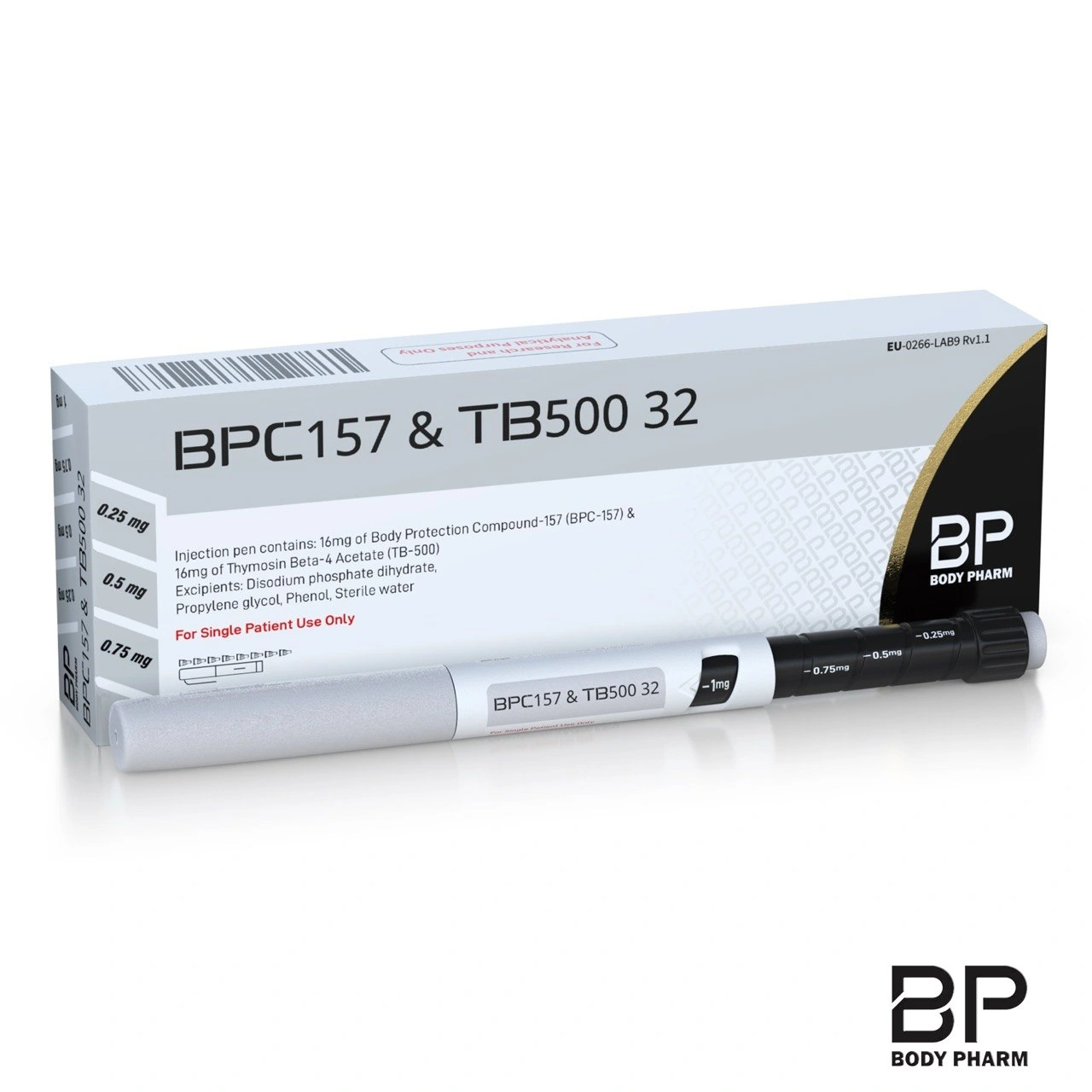
BPC-157 and TB-500 should be compared through the studies behind their claims, not only the slogan “local versus systemic recovery.” That slogan is not an established human head-to-head result. It can make two complicated evidence histories appear to be a simple treatment-selection chart.
For Bali readers considering the combined pen, this guide examines the evidence question separately from the contents of the blend.
Identify which claim you are trying to assess
A claim about pain relief is different from a claim about tendon repair. A claim about a laboratory pathway differs again from a measured return to sport. Before comparing ingredients, make the outcome explicit.
| Claim being discussed | Evidence that would directly help |
|---|---|
| Less pain in a particular condition | A relevant clinical pain outcome |
| Faster return to activity | A defined functional or return-to-activity endpoint |
| Better tissue structure | A suitable structural assessment |
| A benefit from combining ingredients | A comparison able to isolate the combination's contribution |
A paper can be scientifically useful without answering every row. The mistake is extending its conclusion beyond the question it investigated.
What the BPC-157 knee report contributes
A small retrospective study described experience after intra-articular BPC-157 for knee pain, including some combination use. It was not a randomized controlled trial of a retail subcutaneous blend. Its design cannot establish which ingredient caused any reported improvement. Read the original report.
The report is a reason to ask further research questions, not a universal answer for every injury. A knee-pain observation also cannot automatically be relabelled as proof that a damaged tendon healed faster.
Why thymosin beta-4 references need careful naming
A randomized human trial of thymosin beta-4 used an ophthalmic preparation and dry-eye endpoints. That is a specific intervention involving the eyes. Read the phase-II study.
A link to that trial beside “TB-500” does not establish that a pen contains the same preparation or will produce an effect on a musculoskeletal injury. The precise substance and formulation need to remain attached to the evidence.
When an article uses TB-500 and thymosin beta-4 as loose synonyms, inspect the original study rather than assuming that the terminology is settled by the marketing copy.
A blend adds a separate question
The Peptides in Bali BPC-157/TB-500 pen contains two named ingredients. A blend is not itself a study showing synergy.
To claim that two ingredients work better together, evidence should separate their individual effects from the combined effect. Observing a change after a blend, rehabilitation and other changes cannot identify which part contributed.
For the numerical composition, the blend-label guide answers a different question: how to read the combined contents without counting the full total twice.
Make a recovery question useful in Bali
If a shoulder problem is limiting surfing in Uluwatu or an ankle problem is limiting training in Canggu, start with the diagnosis and function. “I cannot do this movement” is more useful than selecting a product because its category says recovery.
Bring any existing assessment or rehabilitation plan to the clinician responsible for the problem. Ask whether the proposed outcome is pain, function or structural recovery, and how progress would be assessed.
If the condition has not been evaluated, a product comparison should not become the evaluation. Persistent or worsening symptoms can need examination even when an online explanation sounds plausible.
How to read a recommendation from someone else
A personal account can tell you what the person experienced. It usually cannot isolate an ingredient's effect, especially if they changed several things at once.
Ask which diagnosis and outcome the account concerns, and whether there were other interventions. Keep the answer as context rather than treating it as a controlled comparison.
The product guide can help identify the catalogue items, while a clinical assessment addresses whether any proposed intervention belongs in an individual plan.
Frequently asked questions
Is TB-500 automatically the better option for several painful areas?
A general “systemic” description does not establish that treatment rule. Multiple symptoms need their own assessment.
Does BPC-157 act only where it is injected?
The comparison here does not establish a local-only rule or an injection strategy. Do not turn a marketing distinction into a treatment instruction.
Does a study involving both ingredients prove synergy?
Not unless the design can separate the combined contribution from other explanations.
What is the most useful source check?
Match the exact intervention, preparation, participants and endpoint to the claim. If one changes, the conclusion needs to change too.
Sources and further reading
- BPC-157 for Multiple Types of Knee Pain — Lee and Padgett, Alternative Therapies. Source checked 2026-10-19.
- Thymosin beta 4 ophthalmic solution: phase II trial — Sosne and Ousler, Clinical Ophthalmology. Source checked 2026-10-19.