
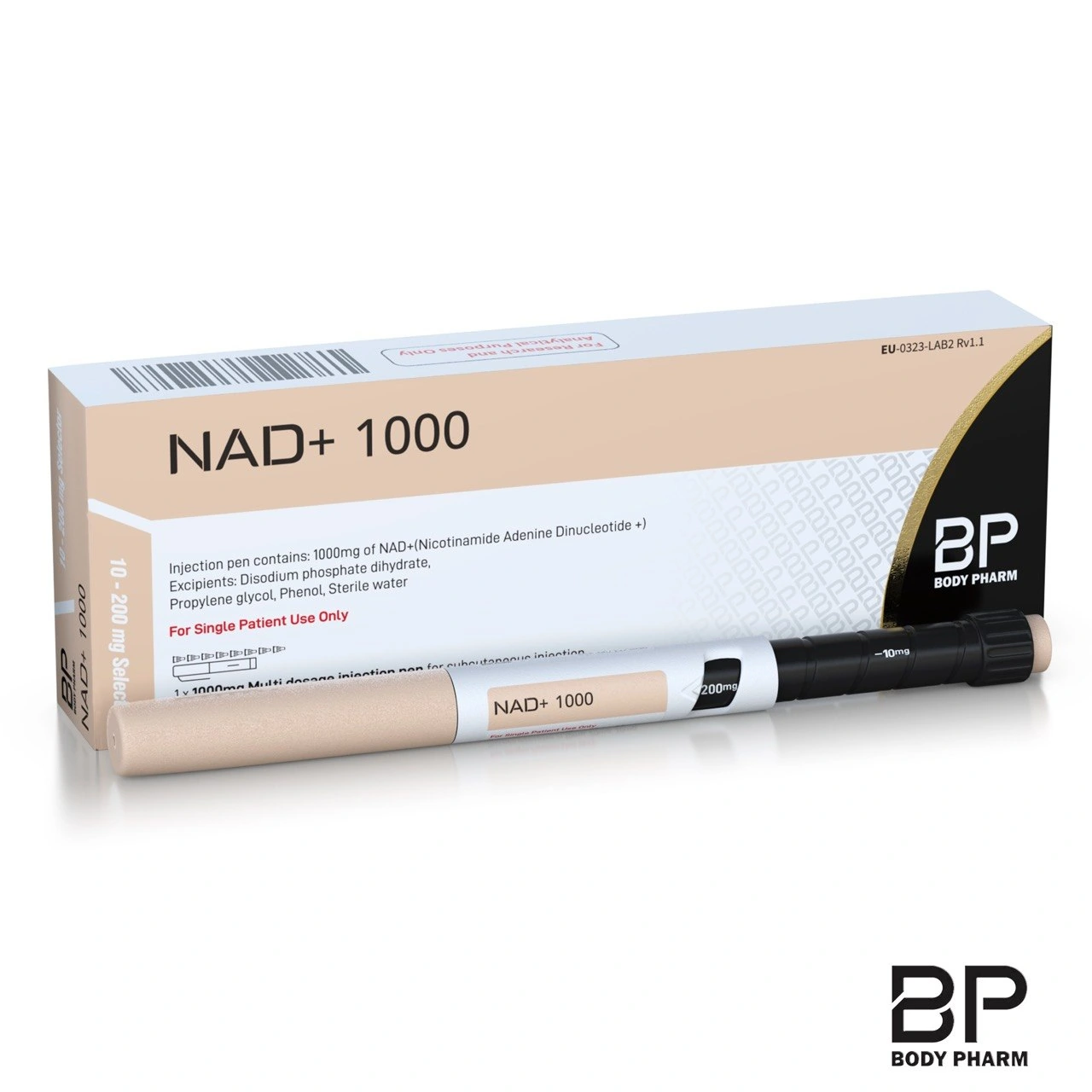
NAD+ and CoQ10 are different coenzymes, not two strengths of one energy supplement. If you are comparing them in Bali, check the exact chemical form and route before comparing claims. A paper about oral CoQ10 plus NADH is not a head-to-head study of CoQ10 and an NAD+ pen.
Our NAD+ listing describes the catalogue presentation. CoQ10 appears here to explain a common comparison, not to imply that the shop supplies an additional supplement or that the two should be combined.
The small difference between NAD+ and NADH matters
NAD+ and NADH are related chemical states, but a study using one should not be cited as if it used any product containing the other. The formulation and route also matter. A biological relationship between molecules does not remove the need to identify the intervention accurately.
CoQ10 is a separate molecule. Its involvement in cellular energy processes explains why it appears in similar discussions, but does not establish the same response to an external product. A pathway diagram tells you where to ask a research question; it does not answer that question on its own.
What a combined oral trial actually tells us
The CoQ10 and NADH trial studied a combined oral intervention in people with chronic fatigue syndrome. When reading it, keep the combination and the diagnosed population visible. It cannot be turned into a statement that one individual ingredient is superior to a different presentation of another.
This is a common source of confusion in product comparisons. A positive result from a combination is assigned to the best-known component, then extended to a product using a different form or route. Each step changes the claim, even if the final sentence still includes a familiar scientific citation.
What an NAD+ pilot studied instead
The intravenous NAD+ pilot assessed metabolic changes during a defined six-hour infusion. It did not establish a general improvement in tiredness from a catalogue pen. The measured outcome and the administered preparation should stay attached to the finding.
| Question | Detail that answers it |
|---|---|
| Was the ingredient NAD+ or NADH? | The intervention section of the paper |
| Was CoQ10 tested alone? | Whether the study used a combination |
| Was it oral, intravenous or another route? | The actual protocol |
| Did people feel less fatigued? | The clinical outcomes, not a metabolism diagram |
The table is a way to read evidence, not a treatment-selection algorithm. A well-described study can still leave important questions unanswered, and acknowledging those questions is more useful than filling them with assumptions.
Make your Bali enquiry specific
If the starting concern is tiredness, describe what that means: sleepiness, reduced training tolerance or persistent fatigue are not identical experiences. Note when it began and whether it affects ordinary activities. A clinician can then decide which information is relevant instead of beginning with an assumed coenzyme problem.
If the starting concern is a product listing, ask for the full ingredient name, format and documents associated with that item. This is a narrower question that can be answered from product information. It should not be confused with an explanation of why a person feels unwell.
For visitors moving between Bali and another country, keep the product details and any medical assessment together. Continuity is easier when the next professional can see exactly what was discussed. A shortened abbreviation or a photograph without the label can leave the most important detail unresolved.
Compare actual formats, not broad promises
Use the shop to identify current catalogue entries and the journal to distinguish other NAD-related research topics. Avoid ranking products by a general phrase such as cellular energy without a defined outcome and relevant evidence.
The same principle applies to quantity. A number on a label cannot establish equivalent exposure or benefit across unlike routes. It becomes informative only when the ingredient, preparation and question are already clear.
FAQ
Does NADH mean the same thing as NAD+ in a study?
No. They are related states, but the exact form used in the intervention must be retained when interpreting the paper.
Does CoQ10 plus NADH evidence prove which ingredient is better?
No. A combination trial does not automatically isolate the contribution of each component or compare them directly.
Can an infusion paper validate an NAD+ pen?
Not by itself. Route, formulation and measured outcomes differ.
What should I compare first?
The full ingredient, route, study population and outcome. Those details are more useful than two unrelated energy claims.
Sources and further reading
- Does oral coenzyme Q10 plus NADH supplementation improve fatigue and biochemical parameters in chronic fatigue syndrome? — Castro-Marrero et al., Antioxidants & Redox Signaling. Source checked 2026-10-22.
- A Pilot Study Investigating Changes in the Human Plasma and Urine NAD+ Metabolome During a 6 Hour Intravenous Infusion of NAD+ — Grant et al., Frontiers in Aging Neuroscience. Source checked 2026-10-22.