
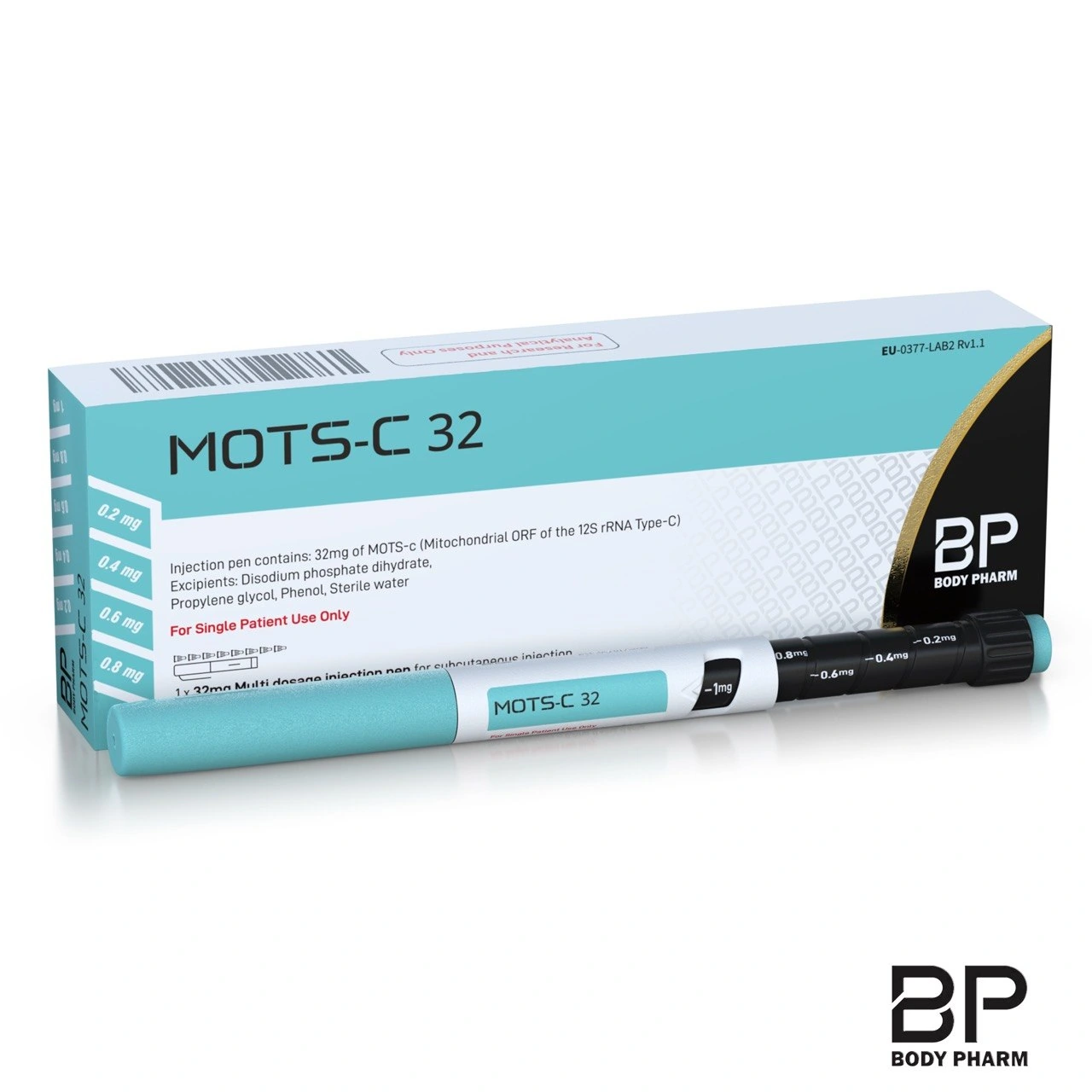
MOTS-C and NAD+ are different substances. MOTS-C is a mitochondria-derived peptide investigated in metabolic signalling. NAD+ is a coenzyme involved in cellular reactions. Their shared appearance in energy and metabolism discussions does not make them interchangeable, and it does not show that using two retail pens together produces an additional benefit.
For someone browsing peptide products in Bali, the useful question is not which name sounds more advanced. It is what was actually studied, whether the study administered the substance being sold, and which outcome it measured.
Why the same category can hide different biology
A category such as vitality or cellular energy helps people navigate a catalog. It is too broad to explain how two substances differ.
| Question | MOTS-C | NAD+ |
|---|---|---|
| What is it? | A mitochondria-derived peptide | A coenzyme |
| What creates confusion? | Turning exercise-related findings into claims about administered pens | Treating evidence from one administration route as evidence for every route |
| What needs checking? | Whether investigators measured natural MOTS-C or administered an intervention | The exact route, formulation and outcome studied |
| Does a shared category prove equivalence? | No | No |
The distinction between something the body contains and a product administered from outside it is central. Measuring a naturally occurring substance after exercise is not the same experiment as testing a pen.
MOTS-C: the research question matters
The foundational MOTS-C paper described a mitochondrial peptide and explored metabolic pathways in experimental systems. It helped establish a research direction; it was not a clinical demonstration that a retail MOTS-C pen improves the everyday energy of people visiting Bali.
A later exercise and MOTS-C study included measurements of naturally occurring MOTS-C around exercise in humans, alongside separate experimental work. The human exercise component did not test customers using a commercial MOTS-C pen. Combining those parts into one simplified “exercise replacement” claim changes what the research showed.
The Peptides in Bali MOTS-C page identifies the catalog product. To interpret a supporting paper, check its intervention separately from that product listing.
NAD+: an IV study is not a pen comparison
A human IV NAD+ pilot study tracked NAD-related metabolites during and after an infusion. Its measurements address a particular administration route and observation period. They do not establish that a NAD+ pen is clinically equivalent to an IV appointment, or that adding MOTS-C improves the result.
The NAD+ pen page and a Bali clinic's IV listing therefore answer different practical questions. One describes a product. The other may describe a service involving assessment and monitoring. Neither can stand in for a direct comparison of clinical outcomes.
What does a two-pen bundle tell you?
The Feel Good Mode bundle brings MOTS-C and NAD+ together as a catalog pairing. That makes it easier to view the two products in one place. It is not, by itself, evidence from a trial of the combination.
Keep three questions separate:
- What does each item contain?
- What evidence exists for each substance and route?
- Has the exact combination been studied for the outcome being discussed?
Evidence for the first two questions does not automatically answer the third. A bundle name also cannot establish personal suitability, an administration plan or a predictable result.
A useful Bali comparison starts with a specific question
If you are staying in Pererenan for a month and comparing options described as supporting an active routine, define the problem you want professional advice about. A vague aim such as “more energy” can conceal very different concerns. A product category cannot identify their cause.
Then ask the provider to identify the study behind the particular claim, rather than sending a long list of unrelated mitochondrial papers. Ask whether its participants resembled the group being discussed, what intervention they received and what changed.
Changing accommodation between Canggu and Uluwatu adds a separate logistical question: who can answer a product query after the handover? Confirm the actual arrangement with the seller or practitioner. Do not assume that a Bali-wide heading guarantees a particular follow-up service.
Read the evidence without losing the practical question
There is no need to become a molecular biologist to make a clearer comparison. Start with the identity of the substance, then the route, the study population and the measured outcome. If one of those is missing, mark it as unknown rather than filling the gap with the bundle's marketing language.
This approach also keeps a product question from becoming a claim about treating unexplained symptoms. Research interest and personal medical suitability are different decisions.
Frequently asked questions
Is NAD+ a peptide like MOTS-C?
No. NAD+ is a coenzyme. MOTS-C is a peptide. They can appear in the same category without belonging to the same chemical class.
Does a rise in natural MOTS-C after exercise prove that a pen replaces exercise?
No. An exercise measurement and a trial of an administered product are different types of evidence.
Does buying both pens establish that the combination is better?
No. A catalog pairing does not establish an additional clinical benefit. That requires evidence for the actual combination and outcome.
Sources and further reading
- Mitochondrial-derived peptide MOTS-c and metabolic homeostasis — Lee et al., Cell Metabolism. Source checked 2026-10-19.
- MOTS-c and exercise-induced mitochondrial regulation — Reynolds et al., Nature Communications. Source checked 2026-10-19.
- NAD+ metabolome during six-hour IV infusion — Grant et al., Frontiers in Aging Neuroscience. Source checked 2026-10-19.