
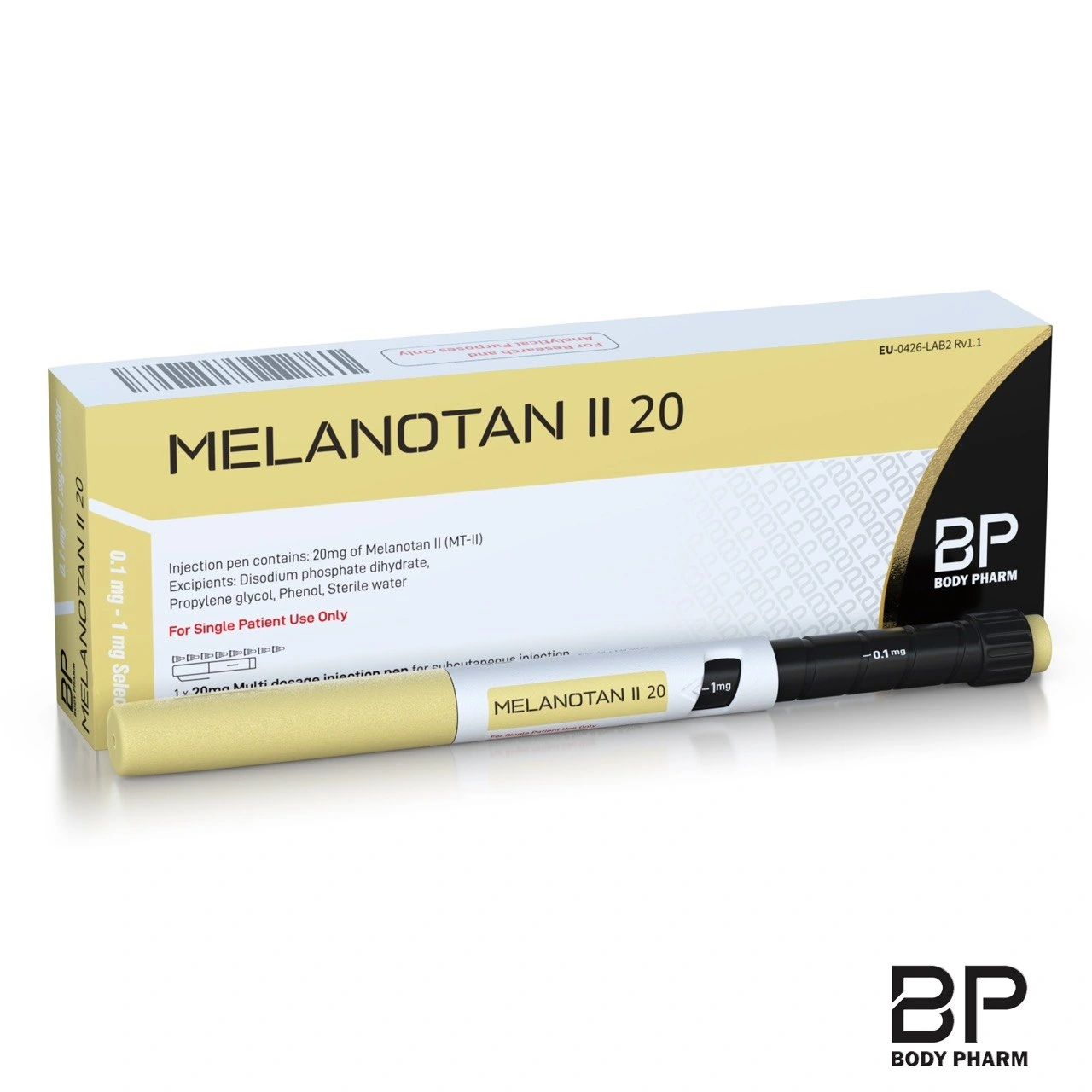
Afamelanotide and Melanotan II are different molecules, even though both appear in melanocortin-related discussions. For a Bali buyer, the most important distinction is that Scenesse is a specific afamelanotide implant with a defined medical indication. Its authorization is not an approval of a separate Melanotan II pen.
The Melanotan II product page identifies Peptides in Bali's catalogue item. It should not be read as a Scenesse listing or an alternative delivery format of that medicine.
Keep the molecule, brand and format together
The European Medicines Agency's Scenesse assessment describes afamelanotide used for adults with erythropoietic protoporphyria, or EPP. The product is an implant, not a generic label for all pigmentation-related peptides.
The Scenesse prescribing information also attaches instructions to that particular preparation and clinical setting.
| Name or feature | What it identifies | What it does not establish |
|---|---|---|
| Afamelanotide | A particular active molecule | Identity with Melanotan II |
| Scenesse | A specific afamelanotide medicine | Approval of every related peptide product |
| Implant | The medicine's delivery format | Equivalence to a pen |
| EPP indication | A defined medical use | A general cosmetic tanning indication |
| Melanotan II pen | A separately listed product | That it is the approved implant medicine |
A comparison that drops any of these details can imply a connection the regulatory assessment does not make.
Similar biological discussion is not the same molecule
Related molecules can be studied within the same broad signalling field while still differing in structure, effects and evidence. A shared research family should not be used as shorthand for clinical equivalence.
An early Melanotan II phase I pilot study investigated that peptide experimentally. It is a different source from a regulatory assessment of Scenesse.
The pilot study does not authorize contemporary commercial Melanotan II products. Equally, the existence of an approved afamelanotide medicine does not fill every evidence gap for a different molecule.
The condition studied is part of the comparison
EPP is a specific medical condition. Its presence in the Scenesse indication should remain visible whenever the medicine is discussed. A person seeking a cosmetic appearance change has not thereby established the same clinical situation.
This matters because a short phrase such as “approved pigmentation peptide” can conceal the diagnosis, product and setting. The missing information changes what the statement means.
If someone has an established photosensitivity condition, they need advice directed at that diagnosis. A catalogue comparison is not a way to identify the condition or replace specialist care.
Why delivery format is not merely a convenience choice
An implant and a pen are different preparations. Their handling, release characteristics and clinical use cannot be assumed equivalent because both involve a peptide.
A product substitution needs evidence and an appropriate clinical decision. It cannot be derived from two similar names or from comparing the labelled amounts.
This article therefore does not convert implant instructions into pen instructions or suggest an administration schedule. The purpose is to make the comparison accurate before any further discussion.
Useful questions for a Bali enquiry
When a product is described using a medicine's research or approval, ask three precise questions: is the molecule the same, is the preparation the same and is the claimed use the same? A mismatch in any one of them needs to be explained.
For a local clinical consultation, bring the exact product name and the source of the claim. A full document is more useful than a cropped line saying that a related medicine is approved.
For commercial identity, return to the Melanotan II listing. Ask for documentation about that product rather than treating a Scenesse paper as a substitute.
Avoid a second naming confusion
Melanotan II is also sometimes confused with melatonin because the names look similar. Melatonin is a different topic altogether. The Melanotan II versus melatonin guide addresses that confusion.
Together, these distinctions help keep a search focused: identify the actual molecule, then the actual product, then the evidence relevant to the question. A familiar-looking name should not decide the interpretation.
FAQ
Is afamelanotide another name for Melanotan II?
No. They are different molecules. Similar biological context does not establish identity.
Does Scenesse approval validate a Melanotan II pen?
No. The approval and prescribing documents concern a particular afamelanotide implant and indication.
Can the implant's instructions be adapted to a pen?
This comparison does not establish such a conversion. Different preparations require their own evidence and clinical instructions.
What is the simplest way to check an approval claim?
Keep the molecule, brand, formulation, indication and jurisdiction together. If a claim changes one of those details, the original approval cannot simply be transferred.
Sources and further reading
- Scenesse: European public assessment report — European Medicines Agency. Source checked 2026-10-20.
- Scenesse prescribing information — DailyMed / Clinuvel. Source checked 2026-10-20.
- Evaluation of melanotan-II, a superpotent cyclic melanotropic peptide in a pilot phase-I clinical study — Dorr et al., Life Sciences. Source checked 2026-10-20.