
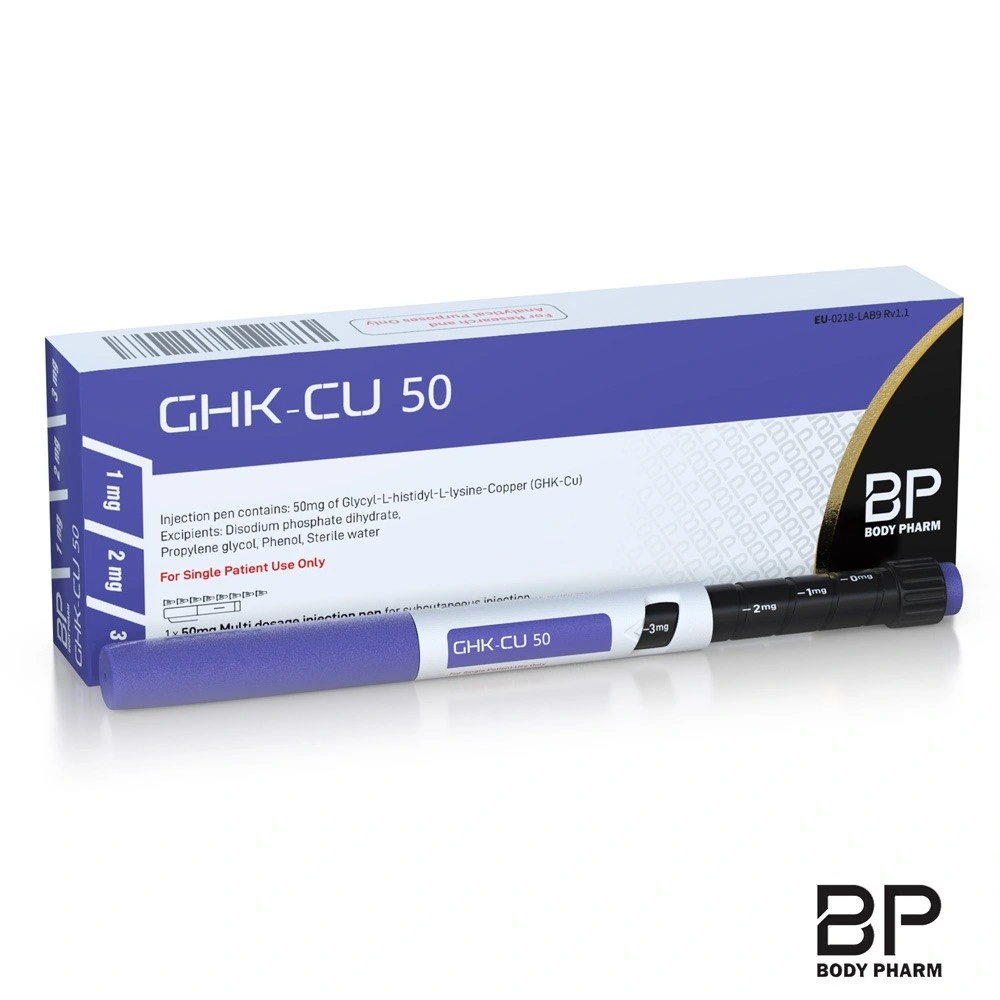
GHK-Cu and retinol are not interchangeable skin ingredients. If you are comparing a GHK-Cu pen with a retinol product in Bali, you are also comparing different formats and routes. Evidence about one topical formulation cannot answer every question about a peptide pen.
Peptides in Bali's GHK-Cu listing identifies the catalogue format. Retinol is discussed here as a skincare comparator, not as another ingredient in that pen.
Compare the actual preparation before comparing the claim
Retinol is a form of vitamin A used in topical skincare research. GHK-Cu is a copper-binding peptide complex. Both may appear in discussions of skin structure, but an overlapping theme does not make the molecules or products equivalent.
The most useful comparison states what was applied, where it was applied and what was measured. “Skin research” on its own is too broad.
| Evidence question | Topical retinol | GHK-Cu pen |
|---|---|---|
| What preparation matters? | The complete topical formulation | The exact pen formulation and route |
| What outcome must be identified? | The skin endpoint measured in the study | A clinically relevant endpoint tested with a matching preparation |
| Can cell research help explain a mechanism? | Yes, within its limits | Yes, within its limits |
| What inference should be avoided? | Every vitamin A product performs identically | A topical or cell result validates the pen |
A percentage on a serum and a labelled amount in a pen are also not the same kind of measurement. Comparing the numbers without their units and formulation context is not meaningful.
What a human retinol trial actually studied
A randomized topical retinol study compared treated and vehicle-treated arm skin in older adults. It assessed clinical signs and biopsy-related measurements over 24 weeks.
The details matter: the participants, skin site, topical formulation and comparator were specified. The study was not a head-to-head comparison against GHK-Cu and did not test a copper-peptide pen.
This is what useful clinical evidence looks like in principle: a defined preparation is linked to a defined result under a defined study design. It still needs interpretation before being applied to a different person or product.
What copper-peptide laboratory research can tell you
GHK-Cu fibroblast research investigated collagen synthesis in cultured cells. Another study involving GHK-Cu and hyaluronic acid used fibroblasts and ex-vivo skin to examine a collagen IV-related endpoint.
These experiments help explain research interest in the ingredient. They do not establish how a particular commercial pen changes visible skin in customers.
A collagen-related laboratory result and a visible clinical change belong to different levels of evidence. Treating them as synonyms can make an article sound more conclusive than the underlying experiment.
Why a mixing question is a different question
“Which has relevant evidence?” is not the same as “can these products be used together?” The second question depends on the complete preparations, route, existing routine and the person's skin and health context.
This article does not provide a layering schedule or an injection-and-skincare protocol. It also does not assume universal compatibility or incompatibility from ingredient names alone.
If the comparison began because an existing routine is uncomfortable or ineffective, show the actual formulations to a qualified professional. Adding a peptide pen does not resolve an unexplained reaction to another product.
Make the Bali context practical
People living in Bali may use several cosmetic products while also considering clinic treatments or catalogue pens. Keep a simple record of what is already being used and the concern each item is meant to address.
For a skin consultation, bring the full product labels rather than only the words retinol and copper peptide. For a catalogue enquiry, use the GHK-Cu pen details to identify the offered preparation. This keeps an ordinary cosmetic question from silently becoming a different medical decision.
The GHK-Cu format guide explains the broader difference between serum and pen language. This article focuses on the retinol comparison and the research designs behind it.
FAQ
Is GHK-Cu a direct replacement for retinol?
The cited evidence does not establish that. They are different ingredients, and a pen-versus-topical comparison introduces an additional route difference.
Does a retinol trial prove GHK-Cu will produce a similar result?
No. A trial supports conclusions about the tested intervention and setting. Shared discussion of skin or collagen does not transfer the result.
Does a cell study prove a visible skin benefit?
Not by itself. Cell experiments can explain biological activity, but a customer-facing claim needs appropriately matched clinical evidence.
What is the most useful first question for a buyer?
Ask whether the claim refers to a topical product, laboratory experiment or the same pen preparation being considered. That distinction often changes the meaning of the comparison.
Sources and further reading
- Improvement of naturally aged skin with vitamin A (retinol) — Kafi et al., Archives of Dermatology. Source checked 2026-10-20.
- Stimulation of collagen synthesis in fibroblast cultures by the tripeptide-copper complex glycyl-L-histidyl-L-lysine-Cu2+ — Maquart et al., FEBS Letters. Source checked 2026-10-20.
- Synergy of GHK-Cu and hyaluronic acid on collagen IV up-regulation via fibroblast and ex-vivo skin tests — International Journal of Cosmetic Science. Source checked 2026-10-20.