
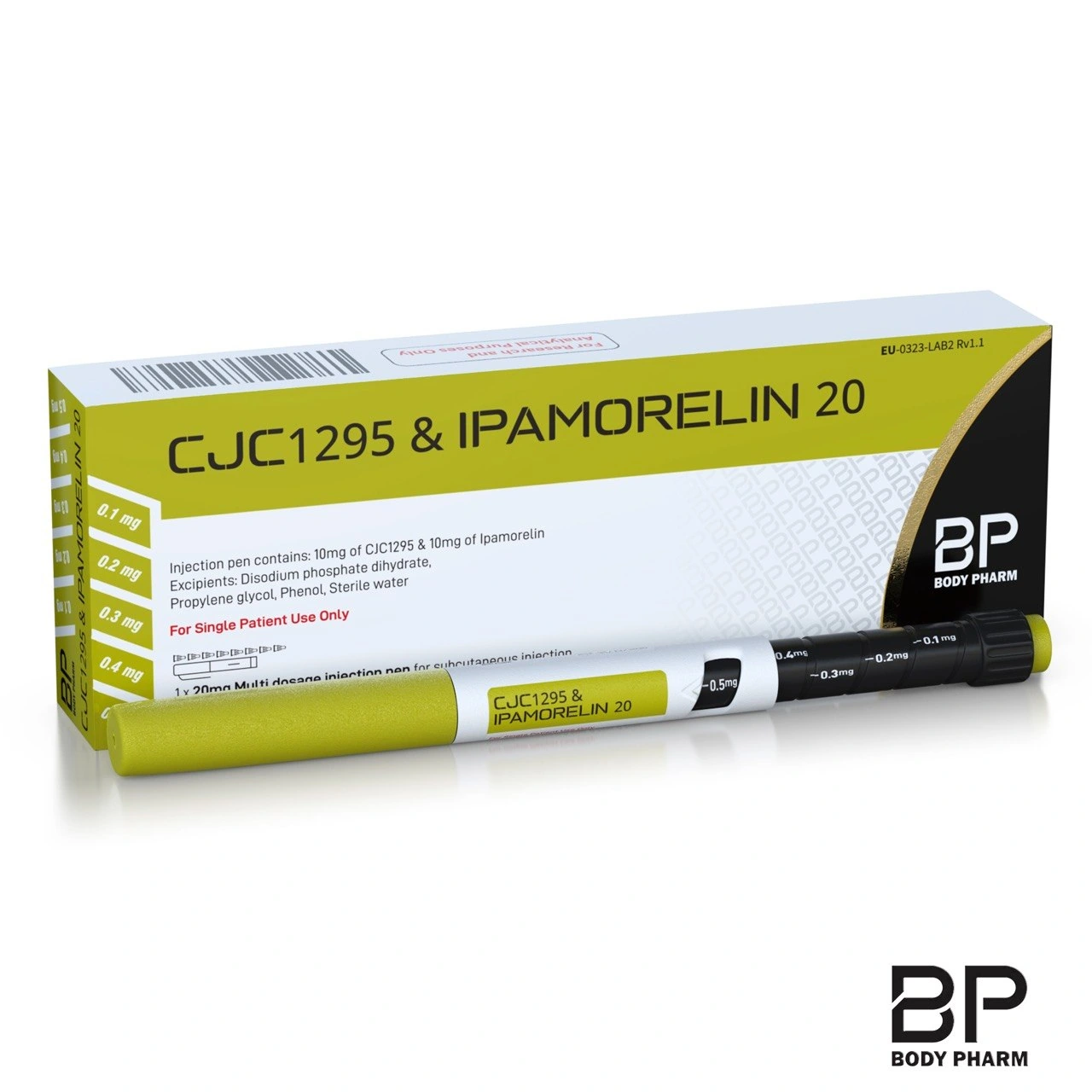
CJC/Ipamorelin and tesamorelin are not interchangeable ways to describe one peptide pen. For a buyer in Bali, the useful comparison starts with the ingredients and the evidence behind the outcome being discussed. A rise in a hormone marker and a change in a defined fat measurement are different results.
Peptides in Bali lists CJC/Ipamorelin and tesamorelin separately. This guide explains why their shared appearance in growth-hormone discussions does not create a single evidence base.
One comparison contains two different product questions
CJC/Ipamorelin combines two named peptide ingredients. Tesamorelin is a different molecule. That already creates an important distinction: a study of CJC alone is not automatically a study of the blend, and a study of a specific tesamorelin medicine is not automatically a study of every pen bearing its ingredient name.
| Comparison point | CJC/Ipamorelin | Tesamorelin |
|---|---|---|
| Ingredient structure of the listing | Two-ingredient blend | A separate peptide ingredient |
| Key identification question | Which CJC preparation and blend are involved? | Which tesamorelin formulation is involved? |
| Evidence often cited | Hormone-response studies of particular ingredients | Research and prescribing information for a specific medicine |
| Shortcut to avoid | Assuming every blend reproduces an ingredient study | Assuming every pen is the named study medicine |
The question “which is best?” remains incomplete until the intended outcome and exact preparation are stated.
A hormone response is not a whole clinical result
A CJC-1295 study investigated a long-acting preparation and measured growth hormone and IGF-1 responses. Those measurements help describe its biological activity. They do not, by themselves, establish a particular change in strength, waist size or daily function for a blended catalogue pen.
The CJC identity matters too. A paper about a long-acting formulation should not be cited as though the abbreviated word CJC uniquely identifies every product. Our CJC blend and DAC guide explains that naming issue.
A separate ipamorelin trial involved postoperative ileus. Its surgical context is different from a fitness comparison. Combining two ingredient names on a label does not combine unrelated trials into proof of a new outcome.
Tesamorelin evidence also has a defined setting
The Egrifta WR prescribing information concerns a specific tesamorelin medicine for excess abdominal fat in adults with HIV-associated lipodystrophy. That is a defined medical setting, not a general description of anyone unhappy with their waist.
A person's visible abdominal shape does not establish that diagnosis or the kind of fat measurement used in research. The clinical question needs to be identified before applying a result.
Equally, a medicine label does not establish that a separately listed tesamorelin pen has the same formulation or authorization. Keep the ingredient-level research and commercial identity separate.
Decide which outcome you are actually comparing
A useful comparison can begin with a simple sentence: “I want to understand evidence about this outcome in this population.” Examples include a measured hormone response, a clinician-assessed condition or a particular body-composition endpoint.
If the source only measures the first of those, it should not be used to promise the third. This prevents a discussion from drifting between meanings of recovery, optimization and fat reduction.
For a resident training in Canggu, a performance concern may call for a different assessment from a diagnosed medical fat-distribution condition. The same catalogue category does not make those scenarios equivalent.
Questions to take to the relevant professional
For a clinical appointment, explain the actual concern, existing diagnoses and current medicines. Ask whether the evidence being discussed applies to that context and who would be responsible for follow-up.
For a product enquiry, ask which ingredients and formulation correspond to the listing and which documents belong to it. That question should be answerable without making a promise about your personal result.
Neither conversation needs an improvised combination plan. The cited evidence does not establish that adding the two products together solves the uncertainty in comparing them.
FAQ
Is CJC/Ipamorelin simply another tesamorelin formulation?
No. The catalogue blend contains different named ingredients. Sharing a growth-hormone-related discussion does not make the products equivalent.
Does higher IGF-1 prove a reduction in visceral fat?
No. A marker response and a specific fat endpoint are different measurements. The latter needs evidence that actually measured it in a relevant setting.
Can Egrifta research identify the tesamorelin pen on this site?
It helps explain tesamorelin's medical research context, but it does not identify or authorize a separate commercial preparation. Product-specific documents remain necessary.
Which page should I use for the actual formats?
Use the separate CJC/Ipamorelin and tesamorelin listings. Compare the evidence questions here before interpreting the listings as a personal treatment choice.
Sources and further reading
- Prolonged stimulation of growth hormone and insulin-like growth factor I secretion by CJC-1295 — Teichman et al., Journal of Clinical Endocrinology & Metabolism. Source checked 2026-10-20.
- Egrifta WR prescribing information — US Food and Drug Administration. Source checked 2026-10-20.
- Ipamorelin for postoperative ileus: a randomized study — Beck et al., International Journal of Colorectal Disease. Source checked 2026-10-20.